John Taylor's 1886 Revelation and Plural Marriage Covenant
Under the Banner of HeavenJohn Taylor’s 1886 revelation and the plural-marriage covenant formed around it became a foundational precedent for Mormon Fundamentalists who rejected the church’s abandonment of plural marriage. In the account, a private revelation declares the practice still binding; a gathering of trusted followers commits to defend it; and a small group receives authority to carry it forward. The episode turns a dispute over doctrine into a dispute over religious authority, communal obligation, and the power of competing legal orders.
Background: Revelation and contested authority
Mormonism had made personal revelation central to religious life from its beginning. Joseph Smith encouraged followers to seek direct impressions from God, but that invitation carried a problem for institutional authority: if believers could receive guidance for themselves, they might receive revelations that contradicted the prophet’s. In 1830, the same year the church was incorporated, Joseph Smith announced a revelation reserving the reception of commandments and revelations for church doctrine to himself. The effort to restrict independent revelation did not eliminate it. Believers continued to regard divine communication as meaningful in personal and theological matters, and disagreements over who could receive authoritative revelation helped produce continuing schisms.
Plural marriage became a particularly consequential test of that conflict. Some dedicated Saints regarded Wilford Woodruff’s Manifesto as a grave mistake, arguing that it had suspended plural marriage under temporary pressure rather than revoked the doctrine in scripture. They appealed to Joseph Smith’s 1843 revelation on plural marriage, which remained part of accepted Mormon scripture, and to Taylor’s 1886 revelation as evidence that the obligation endured. In their interpretation, a church policy could not cancel a commandment unless God or an authorized representative explicitly revoked it.
The revelation and its setting
The revelation came on September 26, 1886, while Taylor was staying at the home of John W. Woolley and avoiding federal officials seeking people involved in plural marriage. Its message, as the book recounts it, was that commandments remained binding unless revoked by God or by divine authority, and that the law of plural marriage had not been revoked. The revelation therefore answered a question about whether Joseph Smith’s earlier teaching should be abandoned with a claim of continuing divine obligation.
The account gives the revelation a dramatic setting through a recollection by John W. Woolley’s son, Lorin C. Woolley. During the night, he noticed light beneath the door of Taylor’s room and heard three distinct voices. The next morning, Taylor explained that he had spent the night speaking with Joseph Smith and identified Jesus Christ as the third voice. This reported encounter connected the new revelation to revered earlier figures and presented its authority not as Taylor’s private interpretation, but as a continuation of communications attributed to God, Joseph Smith, and Jesus Christ. The episode’s historical authenticity has, however, been angrily disputed by leaders of the mainstream church.
The covenant and delegated authority
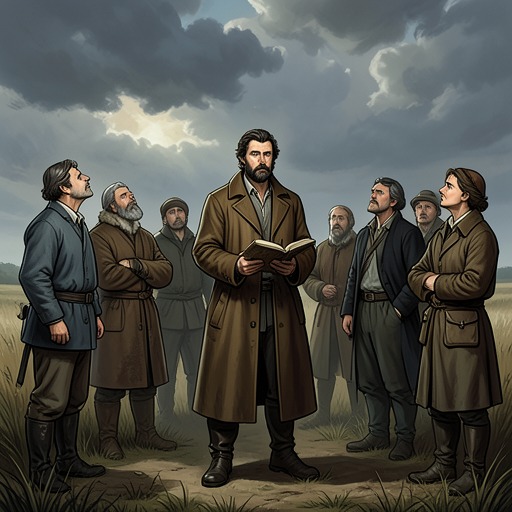
Taylor promptly convened trusted followers to discuss what he had received. Those present included John W. Woolley, Lorin C. Woolley, Samuel Bateman, and Daniel R. Bateman. Taylor placed the assembled group under a covenant to defend celestial, or plural, marriage and to dedicate their lives, liberty, and property to its defense. In this way the revelation became more than a statement of doctrine: the meeting turned it into a collective pledge, binding adherents to a principle they believed the church and government were moving to suppress.
Taylor warned the group that their commitment could bring ostracism, expulsion from the church, or even the loss of their lives. He then selected five of those present, including Samuel Bateman, John W. Woolley, and Lorin C. Woolley, and authorized them to perform celestial marriages and to ordain others to do so. The stated purpose of this delegation was to ensure that plural-marriage families would continue to have children. Authority was thus entrusted to a small group not only to maintain belief, but to reproduce the practice and pass on the capacity to perform it.
The meeting lasted eight hours. Near its end, Taylor prophesied that under the church’s seventh president it would fall into temporal and spiritual bondage, and that the figure called the One Mighty and Strong in Section 85 of the Doctrine and Covenants would appear. The prophecy added an expectation of future correction to the immediate covenant: adherents could understand their resistance not as an isolated defiance, but as part of a longer religious history in which an authorized figure would eventually set the church in order.
Legacy and significance
The revelation and covenant became part of the grounds on which Mormon Fundamentalists refused to accept the ending of plural marriage. The account describes the 1886 meeting as the sowing of the movement’s seeds. Four years later, the church sustained the Manifesto and ended official support for plural marriage; fundamentalists nevertheless maintained that Taylor’s covenant and the underlying doctrine remained binding. The date associated with the revelation became sacred to adherents, who looked forward to the arrival of the prophesied figure who would restore order to the church.
The episode also belongs to a broader contest between religious and civil authority. In nineteenth-century Utah, Brigham Young’s followers argued that divine law took precedence over human law, and local institutions were shaped to favor church authority when the two conflicted. By contrast, later adherents described plural marriage as a constitutionally protected religious belief and objected to government intrusion into their homes. The covenant’s language of consecrating liberty and property gave this position a demanding communal form: it asked followers to commit themselves not only to a belief, but to defending a rival account of legitimate authority.
Its reach extended beyond those present. In the book’s account, the revelation helped furnish a justification for later fundamentalist communities, even as the meeting’s authenticity remained contested. Its lasting force lay in the chain it established: a revelation claimed by a prophet, a covenant accepted by followers, and delegated authority intended to keep the practice alive. That chain offered adherents a way to treat institutional change not as the final word, but as a break from a commandment they believed had never been withdrawn.